
Making a Camping Meal Plan
Step 1: Head Count
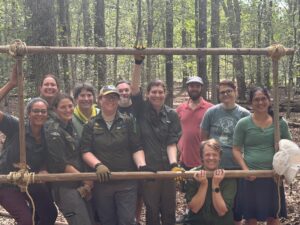
The 17th Black Bears Advanced Leader Training 2026
Determine how many people you are going to feed, how many meals, and what food restrictions/allergies you need to accommodate. For example, you may have campers who are allergic to tree nuts or dairy, and others who are gluten-free. Having fun at camp means not feeling sick, so we want to do our best to accommodate food restrictions and manage cross-contamination.
Understanding Allergies vs. Dietary Restrictions
When making your meal plan, it is important to understand the differences between allergies and dietary restrictions and the nature of the allergy. You don’t have to get all in the gory details of your scout’s health situation, but it does matter if the scout has celiacs and cross-contamination poses a serious risk of stomach upset vs. a food restriction, like someone who is vegetarian or vegan for religious or other personal reasons, vs. someone who is allergic and they risk going into anaphylactic shock if they smell their trigger food. This dictates your meal plan. A person who has a restriction needs to have options that meet their needs. A person who has the potential to go into anaphylactic shock means that food is not allowed at camp.
Cooking in Patrols
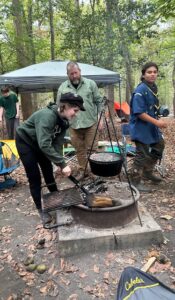
If you are cooking for a large number of people, it may be easier to think of your meal plan in terms of patrols, or smaller subgroups of 8 to 10 people each. The first obvious breakdown is by age group, Otters can have a separate meal plan than Pathfinders. But then you can further think in terms of patrols/rafts/sixes, however that works for your group. This can be one way to manage cross-contamination risks for some allergy-prone foods.
For example, the Blue Patrol eats gluten-free and dairy-free, the Red Patrol is beef and night-shade-free. Maybe everyone is eating the same basic thing, but there’s no cheese in the bag for Blue Patrol’s chili, or a dairy-free cheese, and Red Patrol has a chicken-based stew instead, since chili isn’t nightshade friendly. But everyone is cooking stew-like food in a Dutch oven over a campfire, getting the same basic scouting experience.
Meal Planning the Curriculum
As the scout leader, you have a responsibility to do your best to incorporate scouting fun and learning into the things you do at camp. We want the kids to have a great time, but we want that time to also be building into the bigger ideas of learning to take care of yourself, learning to work together with your team, and building confidence to do hard things. To that end, the meal plan for the camping trip can be part of the learning experience for your scouts.
Think about each of the age groups and the goals of the programs. What are your scouts ready to try to do for themselves and what are you ready to let them try?
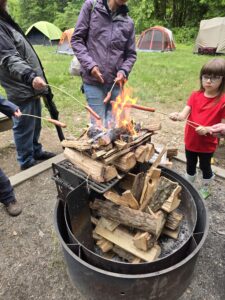
For Otters, the goal of the program is to demonstrate and let them try different skills. We want them to have fun and we want to keep them engaged, while giving them a chance to explore. Cooking at camp for Otters should be simple, and is mostly done by the adults with the kids helping. Think about kid-friendly foods that are quick to put together and have limited actual cooking time. Roasting hot dogs on sticks can be fun at this age, as are walking tacos (where the taco meat is cooked in advance and just needs to be heated up on a stove). Sausage links that are already pre-cooked are a great option for breakfast with fruit and yogurt. Otters can help heat up the sausages and they just need to be warmed up, no worries about if they are cooked all the way through.
Timberwolves are learning to take care of themselves and to try new things, and that it is ok to not get things right the first time. Honestly, pancakes are kind of great for this except for they can require a lot of help from the adults. But kids love it and even if one is burnt a bit, it is still a pancake. Kids this age also love walking tacos.
Pathfinders are still learning to take care of themselves and try new things…but now they have to add in team dynamics and have to figure more of it out for themselves. You want to plan things that Pathfinders can do themselves, but also, you need to set them up for success with this by making sure they have what they need. We’ll talk about this more in Step 4, but making sure each patrol has all their ingredients and a physical copy of the recipe printed out is important. The instructions should be clear and explicit. And having foods that have some wiggle room in them is perfect for this age group. So here is where your chili, stew, and cobbler come in. Foil packs are another great option. They are all pretty forgiving recipes and cooking your dinner over a fire is empowering. It just is.
Step 2: Pick Your Meals
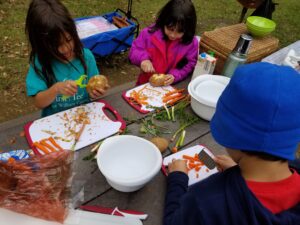
Talk to your scouts about what they think they want to eat. Pathfinders come up with some crazy stuff sometimes. And sometimes you can accommodate it (we have made fondue at camp more than once). But sometimes it is just not going to work. For example, pasta is a staple camp food for some folks, but often doesn’t work with a group that includes gluten-free folks.
Once you have some ideas, map it out on a meal grid and write down each thing you are planning to eat at each time. You have to see it. Actually write it down.
Here’s an example:
| Day/Time | Meal | Head Count | Notes |
| Friday Dinner | Turkey Chili Salad | 15 | |
| Saturday Breakfast | Eggs Sausage Pancakes | 16 | Dairy-free Vegetarian friendly (keep sausage separate) |
| Saturday Lunch | Sandwich Bar | 16 | GF person does not want bread |
| Saturday Snack | Popcorn | 16 | |
| Saturday Dinner | Foil Packs | 17 | Vegetarian friendly |
| Saturday Dessert | Cobbler two ways | 17 | Cherry choc and peach, Gluten free |
| Sunday Breakfast | Muffins and Fruit | 16 |
Always plan on having a snack in the afternoon. And try to plan meals where you can re-use elements. The milk that goes in the pancake mix on Saturday morning is used in the cobbler Saturday night. Various things from the lunch sandwich bar can be used in the foil packs for dinner.
If you are planning across age groups or for multiple patrols, think about symmetry and when you’ll want to be in a group vs. when you’ll be in your separate age groups. For example, you may all have sandwiches for lunch but set up different assembly stations for each age group. It makes it easier for you to plan essentially one meal for everyone, but it is easy to split it up or separate allergens to different stations if needed. Maybe everyone is having a taco-like thing for dinner. Pathfinders are making chili but the Otters are having walking tacos and the Timberwolves are having burritos. You can find ways to streamline your purchasing, buy a big bag of shredded cheese and divide it three ways, but everyone is still getting their age-group-specific needs met.
Step 3: Make a Grocery List
This is the hardest part. How do you know how much food people are going to eat?
A good rule of thumb is to plan for about 1/4 of a pound of protein in a meal per person. Sandwiches are a bit different (a pound of lunch meat can make about 5-6 sandwiches). Account for the ages of your scouts. Little kids eat less meat than adults usually, but camping makes kids hungry. And they often can eat way more sides than you think. Usually aim for 1/3 of a pound of side dishes per meal per person. So what does that mean…
For chili, about a pound of meat and 1 can of beans is enough for 3-4 people.
Foil packs, 1 pound of meat, 1 pound of potatoes, 1 bell pepper and some carrots is enough for 4-5 people.
Plan for 1 ½ distinct items per person. This means sandwiches, hot dogs, eggs, breakfast sausages. Some people will only eat one. Some will have two, some will not have any. It will average out.
For pancakes, assume 2 ½ per person. This allows for some less-than-perfect pancakes to be lost to the campfire gods. Make sure to include the things you need to add to your pancake mix like eggs, oil or milk.
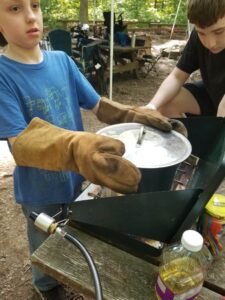
Don’t forget the condiments. Kids will eat more veggies if there is ranch dressing. Adults will happily eat sandwiches and hot dogs if there is mustard, mayo, lettuce, tomato and pickles.
Bring ketchup. Even if you don’t think you are making any ketchup-friendly foods, bring the ketchup. You never know what some kids think you should put ketchup on.
Burnt cobbler and pancakes taste better with whipped cream. A can of squirty whipped cream makes most kids and adults I know happier.
Make sure you have popcorn, apples, string cheese and other snacks on hand. These are great for snack time, but also just have snacks available. Especially for Pathfinders who need to graze for a bit after lunch, having something easy like an apple to take on the after-lunch hike can be really helpful. And dinner can feel like it takes forever if you are waiting for the fire to burn down to coals.
Coffee. Don’t forget sugar and half-and-half.
Make sure to add to your grocery list any consumable non-food items your group uses: trash bags, aluminum foil, paper towels, etc. I like to include a few disposable foil roasting pans in my list. They can be helpful as extra bowls or serving containers. Also, include charcoal, firewood, and ice.
Step 4: Organize
Pack the food by meal as much as you can. Pack coolers in order you will use them. Put all the food for Friday night and Saturday morning in a cooler together. All the food for Saturday night and Sunday morning in a separate cooler. Don’t let anyone open the Saturday Night/Sunday cooler until Saturday night. Things will stay colder longer if the cooler stays closed. 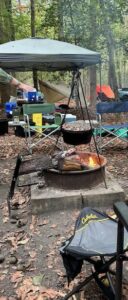
If you have scouts divided into patrols, separate food into patrols as much as you can. Try to divide things so the patrols don’t have to run between each other to find things, or one patrol just assumes they don’t have whatever is on the list because they don’t realize they are supposed to share with the other patrol. This includes salt, cooking oil, and spices. They will leave the salt out of the meal if they can’t find it. I promise.
Don’t assume people know what things are for. Label everything! Masking tape and sharpies are your friends.
Designate a cooler just for ice for putting in drinks. Put a cup or scoop in there so people aren’t touching the ice with their hands.
Tools:
Plan-to-Eat is a great meal planning tool. You can collect and organize recipes, make a plan and it creates a grocery list from your plan. You can get a discount on it using this link. I spend about $25 a year on this and highly recommend it. If you use the link, you can see all the recipes we’ve used over the years.
Follow UP
Be sure to check back, we will be publishing a follow up example of how to do this with a real group.
Written by Melanie Willett